Discovery and exploration
For many thousands of years, humanity, with a few notable exceptions, did not recognize the existence of the Solar System. People believed the Earth to be stationary at the center of the universe and categorically different from the divine or ethereal objects that moved through the sky. Although the Greek philosopher Aristarchus of Samos had speculated on a heliocentric reordering of the cosmos,Nicolaus Copernicus was the first to develop a mathematically predictive heliocentric system. His 17th-century successors, Galileo Galilei, Johannes Kepler and Isaac Newton, developed an understanding of physics that led to the gradual acceptance of the idea that the Earth moves around the Sun and that the planets are governed by the same physical laws that governed the Earth. In more recent times, improvements in the telescope and the use of unmanned spacecraft have enabled the investigation of geological phenomena such as mountains and craters, and seasonal meteorological phenomena such as clouds, dust storms and ice caps on the other planets
Structure :
The principal component of the Solar System is the Sun, a main sequence G2 star that contains 99.86 percent of the system's known mass and dominates it gravitationally. The Sun's four largest orbiting bodies, the gas giants, account for 99 percent of the remaining mass, with Jupiter and Saturn together comprising more than 90 percent.[c] Most large objects in orbit around the Sun lie near the plane of Earth's orbit, known as the ecliptic. The planets are very close to the ecliptic while comets and Kuiper belt objects are frequently at significantly greater angles to it. All the planets and most other objects also orbit with the Sun's rotation (counter-clockwise, as viewed from above the Sun's north pole). There are exceptions, such as Halley's Comet. The overall structure of the charted regions of the Solar System consists of the Sun, four relatively small inner planets surrounded by a belt of rocky asteroids, and four gas giants surrounded by the outer Kuiper belt of icy objects. Astronomers sometimes informally divide this structure into separate regions. The inner Solar System includes the four terrestrial planets and the main asteroid belt. The outer Solar System is beyond the asteroids, including the four gas giant planets. Since the discovery of the Kuiper belt, the outermost parts of the Solar System are considered a distinct region consisting of the objects beyond NeptuneKepler's laws of planetary motion describe the orbits of objects about the Sun. According to Kepler's laws, each object travels along an ellipse with the Sun at one focus. Objects closer to the Sun (with smaller semi-major axes) travel more quickly, as they are more affected by the Sun's gravity. On an elliptical orbit, a body's distance from the Sun varies over the course of its year. A body's closest approach to the Sun is called its perihelion, while its most distant point from the Sun is called its aphelion. The orbits of the planets are nearly circular, but many comets, asteroids and Kuiper belt objects follow highly elliptical orbits. Due to the vast distances involved, many representations of the Solar System show orbits the same distance apart. In reality, with a few exceptions, the farther a planet or belt is from the Sun, the larger the distance between it and the previous orbit. For example, Venus is approximately 0.33 astronomical units (AU)[d] farther out from the Sun than Mercury, while Saturn is 4.3 AU out from Jupiter, and Neptune
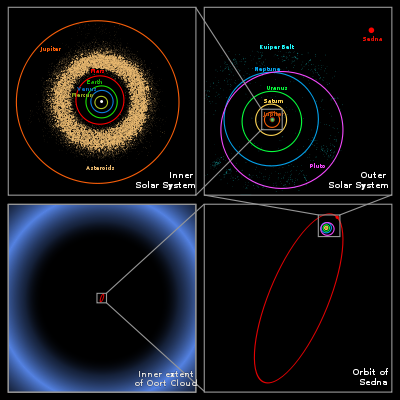
lies 10.5 AU out from Uranus. Attempts have been made to determine a relationship between these orbital distances (for example, the Titius–Bode law), but no such theory has been accepted. Most of the planets in the Solar System possess secondary systems of their own, being orbited by planetary objects called natural satellites, or moons (two of which are larger than the planet Mercury), or, in the case of the four gas giants, by planetary rings; thin bands of tiny particles that orbit them in unison. Most of the largest natural satellites are in synchronous rotation, with one face permanently turned toward their parent. The objects of the inner Solar System are composed mostly of rock,[9] the collective name for compounds with high melting points, such as silicates, iron or nickel, that remained solid under almost all conditions in the protoplanetary nebula. Jupiter and Saturn are composed mainly of gases, the astronomical term for materials with extremely low melting points and high vapor pressure such as molecular hydrogen, helium, and neon, which were always in the gaseous phase in the nebula. Ices, like water, methane, ammonia, hydrogen sulfide and carbon dioxide, have melting points up to a few hundred kelvins, while their phase depends on the ambient pressure and temperature. They can be found as ices, liquids, or gases in various places in the Solar System, while in the nebula they were either in the solid or gaseous phase Icy substances comprise the majority of the satellites of the giant planets, as well as most of Uranus and Neptune (the so-called "ice giants") and the numerous small objects that lie beyond Neptune's orbit. Together, gases and ices are referred to as

Sun :
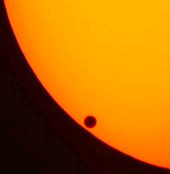
The Sun is the Solar System's star, and by far its chief component. Its large mass (332,900 Earth masses)[13] produces temperatures and densities in its core great enough to sustain nuclear fusion, which releases enormous amounts of energy, mostly radiated into space as electromagnetic radiation, peaking in the 400–700 nm band we call visible light. The Sun is classified as a type G2 yellow dwarf, but this name is misleading as, compared to the majority of stars in our galaxy, the Sun is rather large and bright. Stars are classified by the Hertzsprung–Russell diagram, a graph that plots the brightness of stars with their surface temperatures. Generally, hotter stars are brighter. Stars following this pattern are said to be on the main sequence, and the Sun lies right in the middle of it. However, stars brighter and hotter than the Sun are rare, while substantially dimmer and cooler stars, known as red dwarfs, are common, making up 85 percent of the stars in the galaxy. It is believed that the Sun's position on the main sequence puts it in the "prime of life" for a star, in that it has not yet exhausted its store of hydrogen for nuclear fusion. The Sun is growing brighter; early in its history it was 70 percent as bright as it is today.The Sun is a population I star; it was born in the later stages of the universe's evolution, and thus contains more elements heavier than hydrogen and helium ("metals" in astronomical parlance) than older population II stars. Elements heavier than hydrogen and helium were formed in the cores of ancient and exploding stars, so the first generation of stars had to die before the universe could be enriched with these atoms. The oldest stars contain few metals, while stars born later have more. This high metallicity is thought to have been crucial to the Sun's developing a planetary system, because planets form from accretion of "metals".
Inner Solar System:
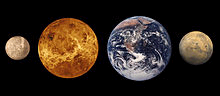
The inner Solar System is the traditional name for the region comprising the terrestrial planets and asteroids. Composed mainly of silicates and metals, the objects of the inner Solar System are relatively close to the Sun; the radius of this entire region is shorter than the distance between Jupiter and Saturn
Asteroid belt
Asteroids are mostly small Solar System bodies[e] composed mainly of refractory rocky and metallic minerals.[44] The main asteroid belt occupies the orbit between Mars and Jupiter, between 2.3 and 3.3 AU from the Sun. It is thought to be remnants from the Solar System's formation that failed to coalesce because of the gravitational interference of Jupiter. Asteroids range in size from hundreds of kilometres across to microscopic. All asteroids save the largest, Ceres, are classified as small Solar System bodies, but some asteroids such as Vesta and Hygiea may be reclassed as dwarf planets if they are shown to have achieved hydrostatic equilibrium.The asteroid belt contains tens of thousands, possibly millions, of objects over one kilometre in diameter.[47] Despite this, the total mass of the main belt is unlikely to be more than a thousandth of that of the Earth.[48] The main belt is very sparsely populated; spacecraft routinely pass through without incident. Asteroids with diameters between 10 and 10-4 m are called

Outer Solar System
The outer region of the Solar System is home to the gas giants and their large moons. Many short period comets, including the centaurs, also orbit in this region. Due to their greater distance from the Sun, the solid objects in the outer Solar System contain a higher proportion of volatiles such as water, ammonia and methane, than the rocky denizens of the inner Solar System, as the colder temperatures allow these compounds to remain solid
Outer planets
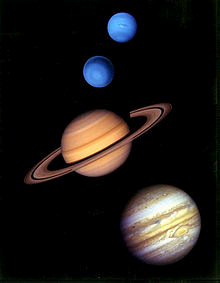
The four outer planets, or gas giants (sometimes called Jovian planets), collectively make up 99 percent of the mass known to orbit the Sun.[c] Jupiter and Saturn are each many tens of times the mass of the Earth and consist overwhelmingly of hydrogen and helium; Uranus and Neptune are far less massive (<20 Earth masses) and possess more ices in their makeup. For these reasons, some astronomers suggest they belong in their own category, “ice giants.”[54] All four gas giants have rings, although only Saturn's ring system is easily observed from Earth. The term outer planet should not be confused with superior planet, which designates planets outside Earth's orbit and thus includes both the outer planets and Mars
Jupiter
Jupiter (5.2 AU), at 318 Earth masses, is 2.5 times the mass of all the other planets put together. It is composed largely of hydrogen and helium. Jupiter's strong internal heat creates a number of semi-permanent features in its atmosphere, such as cloud bands and the Great Red Spot. Jupiter has 63 known satellites. The four largest, Ganymede, Callisto, Io, and Europa, show similarities to the terrestrial planets, such as volcanism and internal heating.[55] Ganymede, the largest satellite in the Solar System, is larger than Mercury
Saturn
Saturn (9.5 AU), distinguished by its extensive ring system, has several similarities to Jupiter, such as its atmospheric composition and magnetosphere. Although Saturn has 60% of Jupiter's volume, it is less than a third as massive, at 95 Earth masses, making it the least dense planet in the Solar System. The rings of Saturn are made up of small ice and rock particles. Saturn has 62 confirmed satellites; two of which, Titan and Enceladus, show signs of geological activity, though they are largely made of ice.[56] Titan, the second largest moon in the Solar System, is larger than Mercury and the only satellite in the Solar System with a substantial
Comets
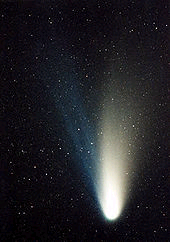
Comets are small Solar System bodies,[e] typically only a few kilometres across, composed largely of volatile ices. They have highly eccentric orbits, generally a perihelion within the orbits of the inner planets and an aphelion far beyond Pluto. When a comet enters the inner Solar System, its proximity to the Sun causes its icy surface to sublimate and ionise, creating a coma: a long tail of gas and dust often visible to the naked eye. Short-period comets have orbits lasting less than two hundred years. Long-period comets have orbits lasting thousands of years. Short-period comets are believed to originate in the Kuiper belt, while long-period comets, such as Hale-Bopp, are believed to originate in the Oort cloud. Many comet groups, such as the Kreutz Sungrazers, formed from the breakup of a single parent.[60] Some comets with hyperbolic orbits may originate outside the Solar System, but determining their precise orbits is difficult.[61] Old comets that have had most of their volatiles driven out by solar warming are often categorised as asteroids
Trans-Neptunian region
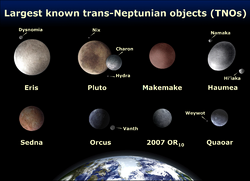
The area beyond Neptune, or the "trans-Neptunian region", is still largely unexplored. It appears to consist overwhelmingly of small worlds (the largest having a diameter only a fifth that of the Earth and a mass far smaller than that of the Moon) composed mainly of rock and ice. This region is sometimes known as the "outer Solar System", though others use that term to mean the region beyond the asteroid belt
Kuiper belt
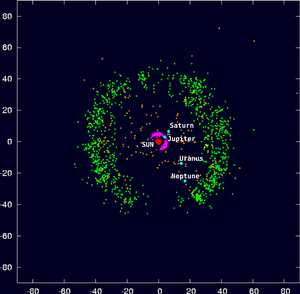
The Kuiper belt, the region's first formation, is a great ring of debris similar to the asteroid belt, but composed mainly of ice.[65] It extends between 30 and 50 AU from the Sun. Though it contains at least three dwarf planets, it is composed mainly of small Solar System bodies. However, many of the largest Kuiper belt objects, such as Quaoar, Varuna, and Orcus, may be reclassified as dwarf planets. There are estimated to be over 100,000 Kuiper belt objects with a diameter greater than 50 km, but the total mass of the Kuiper belt is thought to be only a tenth or even a hundredth the mass of the Earth.[66] Many Kuiper belt objects have multiple satellites,[67] and most have orbits that take them outside the plane of the ecliptic.[68] The Kuiper belt can be roughly divided into the "classical" belt and the resonances.[65] Resonances are orbits linked to that of Neptune (e.g. twice for every three Neptune orbits, or once for every two). The first resonance begins within the orbit of Neptune itself. The classical belt consists of objects having no resonance with Neptune, and extends from roughly 39.4 AU to 47.7 AU.[69] Members of the classical Kuiper belt are classified as cubewanos, after the first of their kind to be discovered, (15760) 1992 QB1, and are still in near primordial, low-eccentricity orbits
Pluto and Charon
Pluto (39 AU average), a dwarf planet, is the largest known object in the Kuiper belt. When discovered in 1930, it was considered to be the ninth planet; this changed in 2006 with the adoption of a formal definition of planet. Pluto has a relatively eccentric orbit inclined 17 degrees to the ecliptic plane and ranging from 29.7 AU from the Sun at perihelion (within the orbit of Neptune) to 49.5 AU at aphelion Charon, Pluto's largest moon, is sometimes described as part of a binary system with Pluto, as the two bodies orbit a barycenter of gravity above their surfaces (i.e., they appear to "orbit each other"). Beyond Charon, two much smaller moons, Nix and Hydra, orbit within the system. Pluto has a 3:2 resonance with Neptune, meaning that Pluto orbits twice round the Sun for every three Neptunian orbits. Kuiper belt objects whose orbits share this resonance are called plutinos
Farthest regions
The point at which the Solar System ends and interstellar space begins is not precisely defined, since its outer boundaries are shaped by two separate forces: the solar wind and the Sun's gravity. The outer limit of the solar wind's influence is roughly four times Pluto's distance from the Sun; this heliopause is considered the beginning of the interstellar medium.[22] However, the Sun's Roche sphere, the effective range of its gravitational dominance, is believed to extend up to a thousand times farther
Heliopause
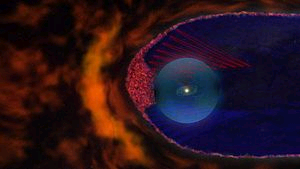
The heliosphere is divided into two separate regions. The solar wind travels at roughly 400 km/s until it collides with the interstellar wind; the flow of plasma in the interstellar medium. The collision occurs at the termination shock, which is roughly 80–100 AU from the Sun upwind of the interstellar medium and roughly 200 AU from the Sun downwind.[78] Here the wind slows dramatically, condenses and becomes more turbulent,[78] forming a great oval structure known as the heliosheath. This structure is believed to look and behave very much like a comet's tail, extending outward for a further 40 AU on the upwind side but tailing many times that distance downwind; but evidence from the Cassini and Interstellar Boundary Explorer spacecraft has suggested that it is in fact forced into a bubble shape by the constraining action of the interstellar magnetic field.[79] Both Voyager 1 and Voyager 2 are reported to have passed the termination shock and entered the heliosheath, at 94 and 84 AU from the Sun, respectively.[80][81] The outer boundary of the heliosphere, the heliopause, is the point at which the solar wind finally terminates and is the beginning of interstellar space.[22] The shape and form of the outer edge of the heliosphere is likely affected by the fluid dynamics of interactions with the interstellar medium[78] as well as solar magnetic fields prevailing to the south, e.g. it is bluntly shaped with the northern hemisphere extending 9 AU farther than the southern hemisphere. Beyond the heliopause, at around 230 AU, lies the bow shock, a plasma "wake" left by the Sun as it travels through the Milky Way.[82] No spacecraft have yet passed beyond the heliopause, so it is impossible to know for certain the conditions in local interstellar space. It is expected that NASA's Voyager spacecraft will pass the heliopause some time in the next decade and transmit valuable data on radiation levels and solar wind back to the Earth.[83] How well the heliosphere shields the Solar System from cosmic rays is poorly understood. A NASA-funded team has developed a concept of a "Vision Mission" dedicated to sending a probe to the heliosphere
Neighbourhood
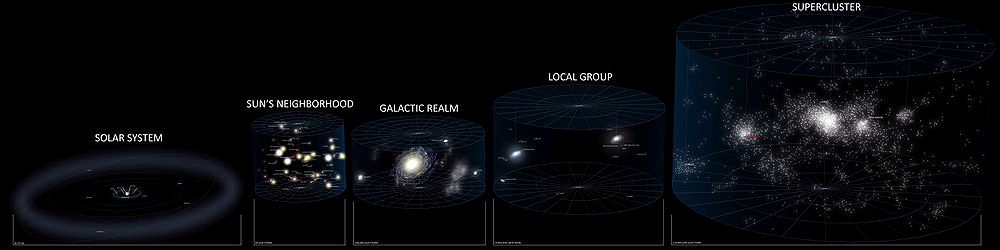
The immediate galactic neighbourhood of the Solar System is known as the Local Interstellar Cloud or Local Fluff, an area of denser cloud in an otherwise sparse region known as the Local Bubble, an hourglass-shaped cavity in the interstellar medium roughly 300 light years across. The bubble is suffused with high-temperature plasma that suggests it is the product of several recent supernovae.[99] There are relatively few stars within ten light years (95 trillion km) of the Sun. The closest is the triple star system Alpha Centauri, which is about 4.4 light years away. Alpha Centauri A and B are a closely tied pair of Sun-like stars, while the small red dwarf Alpha Centauri C (also known as Proxima Centauri) orbits the pair at a distance of 0.2 light years. The stars next closest to the Sun are the red dwarfs Barnard's Star (at 5.9 light years), Wolf 359 (7.8 light years) and Lalande 21185 (8.3 light years). The largest star within ten light years is Sirius, a bright main sequence star roughly twice the Sun's mass and orbited by a white dwarf called Sirius B. It lies 8.6 light years away. The remaining systems within ten light years are the binary red dwarf system Luyten 726-8 (8.7 light years) and the solitary red dwarf Ross 154 (9.7 light years).[100] Our closest solitary sun-like star is Tau Ceti, which lies 11.9 light years away. It has roughly 80 percent the Sun's mass, but only 60 percent its luminosity.[101] The closest known extrasolar planet to the Sun lies around the star Epsilon Eridani, a star slightly dimmer and redder than the Sun, which lies 10.5 light years away. Its one confirmed planet, Epsilon Eridani b, is roughly 1.5 times Jupiter's mass and orbits its star every 6.9 years
Formation and evolution
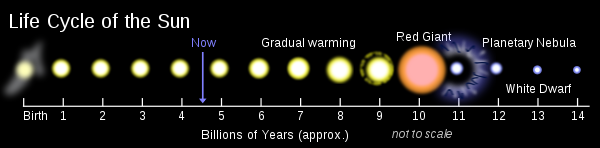
The Solar System formed from the gravitational collapse of a giant molecular cloud 4.568 billion years ago.This initial cloud was likely several light-years across and probably birthed several stars. As the region that would become the Solar System, known as the pre-solar nebula, collapsed, conservation of angular momentum made it rotate faster. The centre, where most of the mass collected, became increasingly hotter than the surrounding disc. As the contracting nebula rotated, it began to flatten into a spinning protoplanetary disc with a diameter of roughly 200 AU and a hot, dense protostar at the centre. At this point in its evolution, the Sun is believed to have been a T Tauri star. Studies of T Tauri stars show that they are often accompanied by discs of pre-planetary matter with masses of 0.001–0.1 solar masses, with the vast majority of the mass of the nebula in the star itself. The planets formed by accretion from this disk. Within 50 million years, the pressure and density of hydrogen in the centre of the protostar became great enough for it to begin thermonuclear fusion.The temperature, reaction rate, pressure, and density increased until hydrostatic equilibrium was achieved, with the thermal energy countering the force of gravitational contraction. At this point the Sun became a full-fledged main sequence star. The Solar System as we know it today will last until the Sun begins its evolution off of the main sequence of the Hertzsprung–Russell diagram. As the Sun burns through its supply of hydrogen fuel, the energy output supporting the core tends to decrease, causing it to collapse in on itself. This increase in pressure heats the core, so it burns even faster. As a result, the Sun is growing brighter at a rate of roughly ten percent every 1.1 billion years. Around 5.4 billion years from now, the hydrogen in the core of the Sun will have been entirely converted to helium, ending the main sequence phase. As the hydrogen reactions shut down, the core will contract further, increasing pressure and temperature, causing fusion to commence via the helium process. Helium in the core burns at a much hotter temperature, and the energy output will be much greater than during the hydrogen process. At this time, the outer layers of the Sun will expand to roughly up to 260 times its current diameter; the Sun will become a red giant. Because of its vastly increased surface area, the surface of the Sun will be considerably cooler than it is on the main sequence (2600 K at the coolest).Eventually, helium in the core will exhaust itself at a much faster rate than the hydrogen, and the Sun's helium burning phase will be but a fraction of the time compared to the hydrogen burning phase. The Sun is not massive enough to commence fusion of heavier elements, and nuclear reactions in the core will dwindle. Its outer layers will fall away into space, leaving a white dwarf, an extraordinarily dense object, half the original mass of the Sun but only the size of the Earth.The ejected outer layers will form what is known as a planetary nebula, returning some of the material that formed the Sun to the interstellar medium